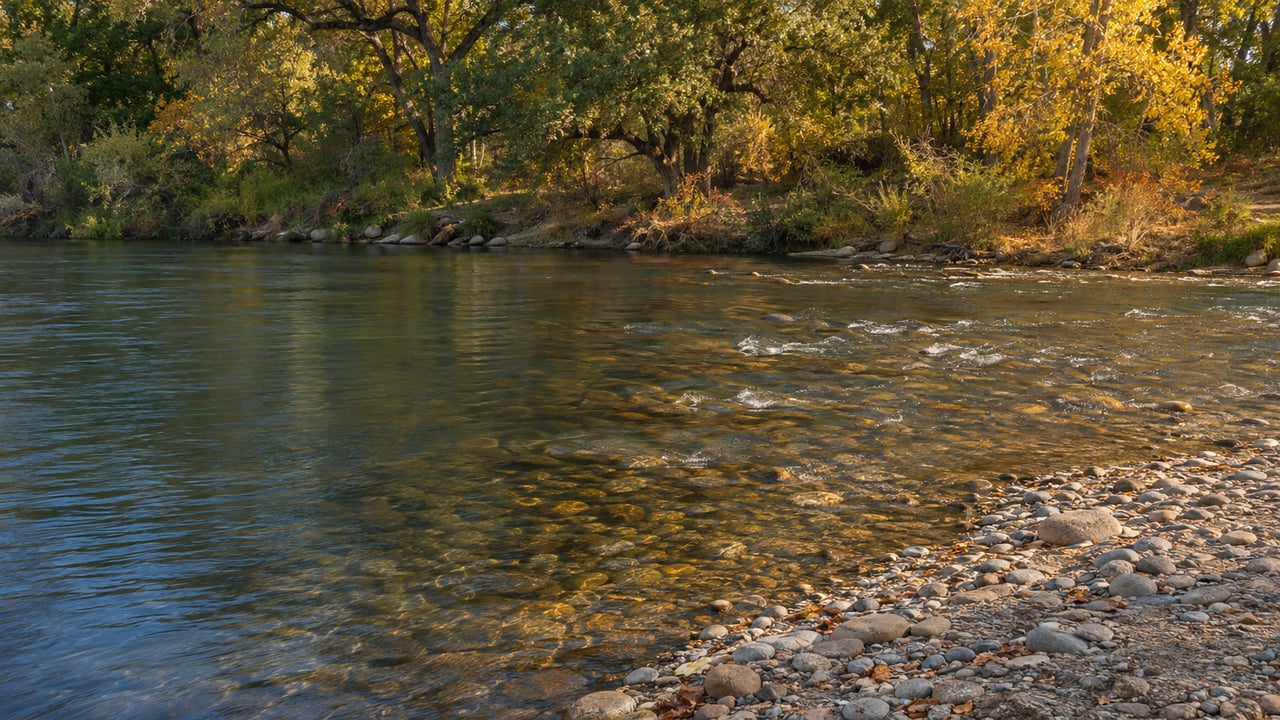
Walk past the public golf course parking lot on Tarshes Drive and down to the river at Ancil Hoffman Park, and you'll see a side channel running about 2,000 feet along the gravel bar. Willows grow along it, and tree trunks are set into the water. It looks like the river made it. The Sacramento Water Forum built it in 2023, along with nearly 5 acres of spawning beds made from 30,000 cubic yards of clean gravel placed straight into the current.
Fall-run Chinook salmon spawn in the lower American River from October through December. Through the rest of this season, the fish digging nests along Carmichael's riverbank are digging in that gravel and in gravel from projects like it. The best places to watch are the places where people put spawning beds back.
Why the river needs the gravel
A female salmon digs her nest, called a redd, in loose gravel in moving water. She lays her eggs, then covers them with more gravel. When the young fish hatch, they move into slower side channels and floodplain edges to grow before heading out to the Pacific.
Folsom and Nimbus dams changed both halves of that cycle. The Water Forum's project page says salmon once used more than 100 miles of river and upper watershed above the dams. The dams also trap the sediment that would naturally refill spawning beds as the current wears them away. So the Water Forum picks sites like Upper River Bend and adds gravel to stay ahead of that loss.
The work goes back years before the Carmichael projects. A June 2019 environmental assessment lists placements from 2008 through 2016 at Upper and Lower Sailor Bar, River Bend, Nimbus Basin and Sacramento Bar. Together they add up to about 92,034 cubic yards. Since 2021, much of the new work has landed in Carmichael.
What went into the river along Carmichael
| Year | Site | Gravel placed | Other work |
|---|---|---|---|
| 2021 | Ancil Hoffman Park, near Effie Yeaw Nature Center | More than 15,000 cubic yards | Rearing alcove for young fish |
| 2023 | Upper River Bend, Ancil Hoffman Park past the golf course lot | 30,000 cubic yards | 2,000-foot side channel, about 60 woody structures |
| 2024 | River Bend, near River Bend Park and William B. Pond Recreation Area | 6,800 cubic yards | 1,800-foot side channel reconnected and deepened, 32 woody structures |
That's close to 52,000 cubic yards in four years along one stretch of riverbank. The 2021 work was a Bureau of Reclamation-funded project, completed that fall. The 2024 River Bend project ran from August through October 2024. In-river work on these projects is timed to finish by the end of October, before salmon come back from the ocean in large numbers.
The redd counts that followed
The best evidence that this gravel matters is where the nests show up afterward.
At the 2021 Ancil Hoffman site, the Water Forum counted 64 Chinook redds in fall 2020. A few months after construction, the count was more than double that. At River Bend, the Carmichael Times reported that biologists counted almost 40 new redds during the 2024 project's first spawning season, in spots that hadn't supported spawning before. An earlier River Bend project from 2013 saw up to 159 Chinook redds and 21 steelhead redds two years after the work was done.
The most dramatic case is upstream. Aerial surveys at Upper Sailor Bar counted zero redds in 2018. In 2019 they counted 1,614, and the site's share of spawning across the whole river went from 0% to 28.6%.
Across these sites, nests appear where the gravel goes in.
How big last year's run was
The California Department of Fish and Wildlife surveys the 13.4 miles from Nimbus Dam down to the Watt Avenue bridge, which is where the spawning happens. Below Watt Avenue, the river has little spawning habitat and mostly serves as a route for fish moving through. All of Carmichael's riverbank falls inside that surveyed reach.
CDFW's 2025–2026 escapement report estimated that 63,308 fall-run Chinook spawned in the river in fall 2025, up from 45,541 in 2024. Another 14,334 swam up the fish ladder into Nimbus Fish Hatchery. Most of those fish came from 2022 spawners, a year when the estimate was 16,383. The report also credits the closed commercial fishery and the limited recreational season with helping the run.
Even so, the 2025 count was well short of the federal goal of 160,000 fall-run Chinook on the American River, set under the Central Valley Project Improvement Act. That gap explains why the gravel work keeps going. In August 2026, the Water Forum announced more than $10.6 million in federal funding, as the Carmichael Times reported. The largest award, $10 million, pays for long-term maintenance, monitoring and enhancement of the sites the Water Forum has built over the past two decades. A December 2025 grant is paying to identify and design up to 10 future habitat sites covering about 30 acres.
When to go
The 2025 survey found peak carcass recovery during December 8–12, which matches the river's historical average. Carcasses peak after spawning does, so the next few weeks are the window to see fish over the gravel. Warmer water tends to push spawning later, so the exact timing shifts from year to year.
On the gravel bars, look for patches of clean, lighter-colored gravel in shallow, moving water. Those depressions are redds, and a fish holding over one is likely guarding or finishing a nest.
Where to stand, in order of how close the gravel is
- Upper River Bend at Ancil Hoffman Park. Park past the public golf course lot on Tarshes Drive. The 2023 side channel and spawning beds are in the river there. The park is open sunrise to sunset, with an $8 vehicle fee.
- The 2021 site near Effie Yeaw Nature Center. The center is at 2850 San Lorenzo Way, but the San Lorenzo entrance is locked. Drive in from Tarshes Drive off California Avenue. Daily parking is $8, and members and County pass holders park free.
- River Bend Park and William B. Pond Recreation Area. The 2024 side channel and gravel are in the river near both parks.
- Sailor Bar and Rossmoor Bar, upstream. Both are open sunrise to sunset year-round, with an $8 vehicle fee. Sailor Bar is listed for nature watching and fishing, and it's the site of the 2008–2012 and 2022 gravel work.
For a guided version, Effie Yeaw Nature Center's family program Scent-sational Salmon runs Monday, November 23, from 10 to 11:30 a.m. It starts with a 30-minute presentation, followed by an hour-long guided river hike to look for salmon. If the weather is bad, a craft replaces the hike.
The other well-known place to see salmon is Nimbus Fish Hatchery in Gold River. Its operations run from the beginning of November through mid-December. The visitor center building is owned by the Bureau of Reclamation and run by CDFW. KCRA reported in September that its planned Labor Day reopening had been pushed back. Before you drive over, check CDFW's hatchery page, which links to the hatchery's Facebook page for current hours. Or skip the drive. The salmon spawning in Carmichael's own gravel beds are a few minutes from home.
Pierre Viard keeps up with the riverside parks along Carmichael's stretch of the American River. If you're thinking about a home near the River Bend or Ancil Hoffman trails, or about selling one, he can walk you through what the parkway means for that part of the neighborhood. Caviard Realty Associates: Work with Pierre and request a neighborhood consultation.