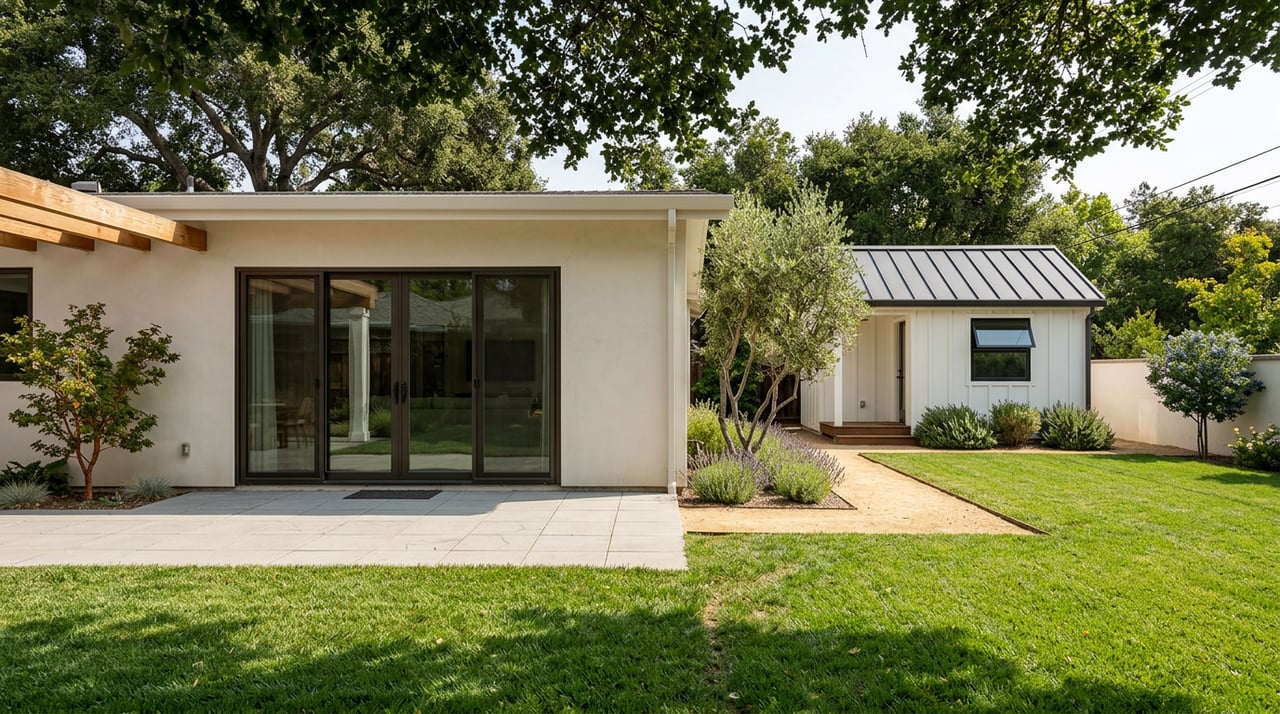
Thinking about adding an ADU or buying a Carmichael property with extra lot room? You’re not alone. Carmichael’s lot patterns, county rules, and rental demand make it a practical place to house-hack, boost yield, or plan a long-term hold. In this guide, you’ll see the local standards that actually affect your numbers, what recent price and rent anchors look like, and a step-by-step checklist to vet a parcel. Let’s dive in.
Why Carmichael is ADU-friendly
Carmichael sits in unincorporated Sacramento County, where low-density residential zoning is common and many parcels meet or exceed minimum lot sizes. The County’s RD-5 zone is widely used, with minimum interior lots of 5,200 square feet and 6,200 square feet on corners. That baseline helps when you screen for workable backyards and setbacks on typical single-family streets. You can review RD-5 and similar zones in the County’s zoning materials that outline minimums and intent for these districts. Refer to the County’s overview of residential zoning for details on RD-5 lot size minimums and patterns in low-density districts (County zoning reference for RD-5 lot sizes).
The County explicitly allows ADUs across residential districts and publishes a concise standards handout that covers size limits, setbacks, parking, and special cases for JADUs. It also explains a shelf-ready plan program that can shorten design time and reduce soft costs. You can start with the County’s summary to see what is allowed on a typical lot (Sacramento County ADU handout).
On timing, Sacramento County’s Building Permits & Inspection group runs a shelf-ready ADU plan library and provides guidance on submittals, permit fees, and coordination with Site Improvement & Permits for impact fees. This is one of the fastest ways to move from concept to permit on a standard detached ADU (Shelf-ready ADU plans and permits).
The rules that shape returns
ADU size, placement, and parking
- Size. Detached ADUs can be up to 1,200 square feet. Attached ADUs are capped at the greater of 50 percent of the primary home or 850 square feet for a studio/1-bedroom and 1,000 square feet for 2+ bedrooms. JADUs are limited to 500 square feet. The minimum habitable size is 150 square feet.
- Setbacks and height. The County’s standards handout outlines typical side and rear setbacks of 4 feet for ADUs, with front setbacks often at 20 feet. Detached ADUs commonly have a 16-foot height limit. Always confirm parcel-specific objective standards.
- Parking. The County generally requires one parking space for an ADU unless an exception applies. Waivers can apply if the ADU is within one-half mile of transit, is a conversion, is 800 square feet or less, there are on-street permit restrictions, a car-share is nearby, or the ADU is accessory to a multifamily structure. These waivers often reduce cost and simplify site layout. See the County’s standards summary for the full list (Sacramento County ADU handout).
Permits, fees, and what to expect
Sacramento County’s Building Permits & Inspection office handles plan check and building permits, while the Site Improvement & Permits Section estimates development impact fees. Both fee types can be material, and they vary by project scope and location. For assumptions, ask BPI and SIPS for itemized estimates early, and get a builder quote that includes utilities and contingencies. County codes also outline how permit fees are calculated based on project valuation (County permit fee methodology reference). For faster starts, explore the County’s shelf-ready plans and use them as a baseline for bids (Shelf-ready ADU plans and permits).
SB-9 pathways and limits
California’s SB-9 created a ministerial path for a second principal dwelling on qualifying single-family parcels and for urban lot splits. Projects must meet objective standards, and some sites are excluded, such as historic properties or parcels affected by recent renter protections or demolition limits. Lot splits require an owner-occupancy affidavit. SB-9 can sometimes pair with ADUs, but be careful: second dwellings under SB-9 are treated differently from ADUs and may trigger full impact and affordable housing fees. Review the law’s text for the big picture and talk to County staff before modeling SB-9 returns (SB-9 bill text on LegInfo).
Short-term rental restrictions
If you planned on short-term rental income from a new ADU, note the County’s rule: ADUs permitted after January 1, 2020 in unincorporated Sacramento County cannot be used as short-term rentals. JADUs and guest houses are not eligible for STR use. Only ADUs legally permitted before that date can operate as STRs, subject to other rules (Sacramento County ADU handout).
Carmichael prices, rents, and what an ADU can add
You want current, local anchors when you underwrite. U.S. Census QuickFacts for 2019–2023 places Carmichael’s owner-occupied rate near 52 percent, a median owner-occupied home value around $541,500, and a median gross rent of about $1,595. These multi-year figures help set a baseline for affordability and housing mix (Census QuickFacts: Carmichael).
For fresher snapshots, Zillow’s Carmichael pages show typical home values in the low-to-mid $500,000s and average observed rents in roughly the $1,700 to $1,900 range in recent readings. Use Zillow to cross-check active rent comps and to view trend lines while noting differences in methodology and timing (Zillow Carmichael market snapshot).
What does that mean for an ADU strategy? In Carmichael’s price band, an ADU can shift gross yield and cash flow for long holds, especially if you optimize design, fees, and parking. The impact is strongest on lots that easily meet setbacks and utility access, or on purchases where a legal, permitted ADU already exists.
Example numbers for context
The following math is illustrative. Always replace with parcel-specific bids, fees, rents, and financing.
- Purchase anchor. Assume a purchase price of $540,000, near recent Carmichael index levels, to orient your model (Zillow Carmichael market snapshot).
- ADU costs. Detached ADU construction in California often falls in the $150,000 to $300,000 range depending on size, finishes, and site work. Verify locally and add design, permits, and utilities to your budget (ADU construction cost guide).
- Rents and operations. ADU rents commonly run $1,200 to $1,800 per month in this submarket depending on size and finish level. Model a 30 to 40 percent operating and vacancy load to cover taxes, insurance, repairs, management, and downtime.
Scenario A: Buy a home with an existing legal detached ADU at a $600,000 price. If the ADU rents for $1,200 per month ($14,400 per year), the immediate gross yield on the total price is about 2.4 percent. After a 40 percent operating load, net ADU cash is around $8,640 per year, which is roughly 1.4 percent on total purchase price from the ADU alone. The main home’s value and rent potential still drive your overall return.
Scenario B: Build an ADU on your own Carmichael lot at an estimated $220,000 construction cost. If it rents for $1,600 per month ($19,200 per year) and you reserve 35 percent for operations and vacancy, net operating income would be about $12,480 per year. That is roughly a 5.7 percent net return on the construction dollars before financing. Appraisers often add meaningful value for ADUs, but not always dollar-for-dollar, and it varies by neighborhood and comps. For perspective on value patterns, see recent appraiser commentary on ADU cost versus value dynamics (ADU value analysis perspective).
Step-by-step: Vetting a Carmichael lot for an ADU
Use this quick process to size up a property before you commit.
- Confirm jurisdiction and zoning
- Use the County’s online resources to verify the parcel is in unincorporated Sacramento County and note the zoning designation. RD-5 and similar residential zones are common in Carmichael and work well for ADU feasibility (Shelf-ready ADU plans and permits).
- Check lot size and setbacks
- Compare lot size to RD-5 minimums and review the County’s ADU standards for typical 4-foot side and rear setbacks, front yard, and height. Larger interior lots above 5,200 square feet usually make site planning easier.
- Review utilities and physical constraints
- Ask about sewer and water laterals, electrical capacity, and potential trenching routes. Check whether the parcel is in or near a flood zone, especially close to the American River. Utility access and flood design can shift costs.
- Apply parking rules
- Determine if a parking space is required or waived based on ADU size, proximity to transit, conversion status, or parking district rules. Parking often drives layout and cost, so lock this in early.
- Get fee and permit estimates
- Request a preliminary building permit fee estimate from BPI and development impact fee estimate from SIPS. Ask builders for turnkey bids that include design, permits, hookups, contingencies, and standard finishes. Shelf-ready plans can reduce soft costs and time (Shelf-ready ADU plans and permits).
- Pull rent comps and set conservative assumptions
- Check 1- and 2-bedroom ADU comps in Carmichael and nearby submarkets. Use Zillow’s trend pages to sanity-check asking rents and apply a vacancy and operating reserve to your model (Zillow Carmichael market snapshot).
- Consider SB-9 as a separate path
- If your lot is large and SB-9-eligible, evaluate the second unit or lot split path. Note the different fees and restrictions that can apply versus a standard ADU, and the owner-occupancy affidavit required for lot splits (SB-9 bill text on LegInfo).
- Model exit and long-term hold
- Compare resale comps for homes with and without ADUs to gauge likely appraisal treatment. Keep exit assumptions conservative and use sensitivity tests for rent and cost swings.
House-hacking and long-term strategies
- Live in one, rent one. Owner-occupy the main house and rent the ADU to offset your mortgage. If you pursue a JADU, remember owner-occupancy rules apply. Check the County’s handout for JADU specifics.
- Rent both units. For pure yield, renting the main home and the ADU can widen gross income on a single parcel, often by 20 to 100 percent depending on sizes and finishes.
- Buy with an existing, permitted ADU. You get immediate income, but the market often prices ADUs into the sales price. Confirm permits, utility metering, and lease history before you underwrite.
- Explore SB-9 over a longer horizon. On large, eligible lots, SB-9 may enable a second principal home or a lot split. Treat it as a separate analysis with fee and standards differences.
Risk checks and red flags
- Unpermitted units. Always verify ADU permits and final inspections. Unpermitted structures can be costly to legalize.
- Hidden utility costs. Sewer/water connections and trenching can swing budgets. Get written quotes early.
- STR limits. New ADUs cannot be used as short-term rentals under County policy. Plan for long-term tenants.
- Parking or access conflicts. Corner lots, narrow driveways, or tree protection conditions can change designs and costs.
- Fee surprises. Development impact fees and permit valuations vary. Ask BPI and SIPS for itemized, parcel-specific estimates before you finalize a pro forma.
How we can help you move from plan to permit
If you want a calm, data-backed path into an ADU build or an ADU-equipped purchase, you deserve hands-on local guidance. You will get help confirming jurisdiction and zoning, reading the County ADU rules, and using shelf-ready plans to speed timelines. You will also get introductions to trusted builders, fee estimate checklists, and referrals for property management after close if you want a true turnkey hold. When you are ready, connect with Pierre Daniel Viard to map your Carmichael options.
FAQs
What ADU sizes are allowed in unincorporated Carmichael?
- Detached ADUs can be up to 1,200 square feet; attached ADUs are limited by percentages and bedroom count thresholds, and JADUs are capped at 500 square feet, as summarized in the County’s ADU handout (Sacramento County ADU handout).
How do Sacramento County parking rules affect an ADU?
- One space is generally required unless an exception applies, such as an ADU that is 800 square feet or less, within one-half mile of transit, a conversion, or in specific parking contexts listed in the County standards.
Are short-term rentals allowed for new ADUs in Carmichael?
- No; ADUs permitted after January 1, 2020 in unincorporated Sacramento County cannot be used as short-term rentals, and JADUs or guest houses are not eligible for STR use.
What is SB-9 and how might it change my plan?
- SB-9 allows a second principal dwelling or an urban lot split on qualifying single-family parcels under ministerial review, but it has site exclusions and different fee impacts than standard ADUs; review the law and consult County staff before modeling returns (SB-9 bill text on LegInfo).
How much does it cost to build a detached ADU in Carmichael?
- A common California range is $150,000 to $300,000 plus design, permits, and utilities, but you should get parcel-specific builder bids and County fee estimates before finalizing a budget (ADU construction cost guide).
How fast can I permit an ADU in unincorporated Sacramento County?
- Timelines vary by scope and submittal quality, but the County’s shelf-ready plan program can reduce design time and streamline review for standard detached ADUs (Shelf-ready ADU plans and permits).